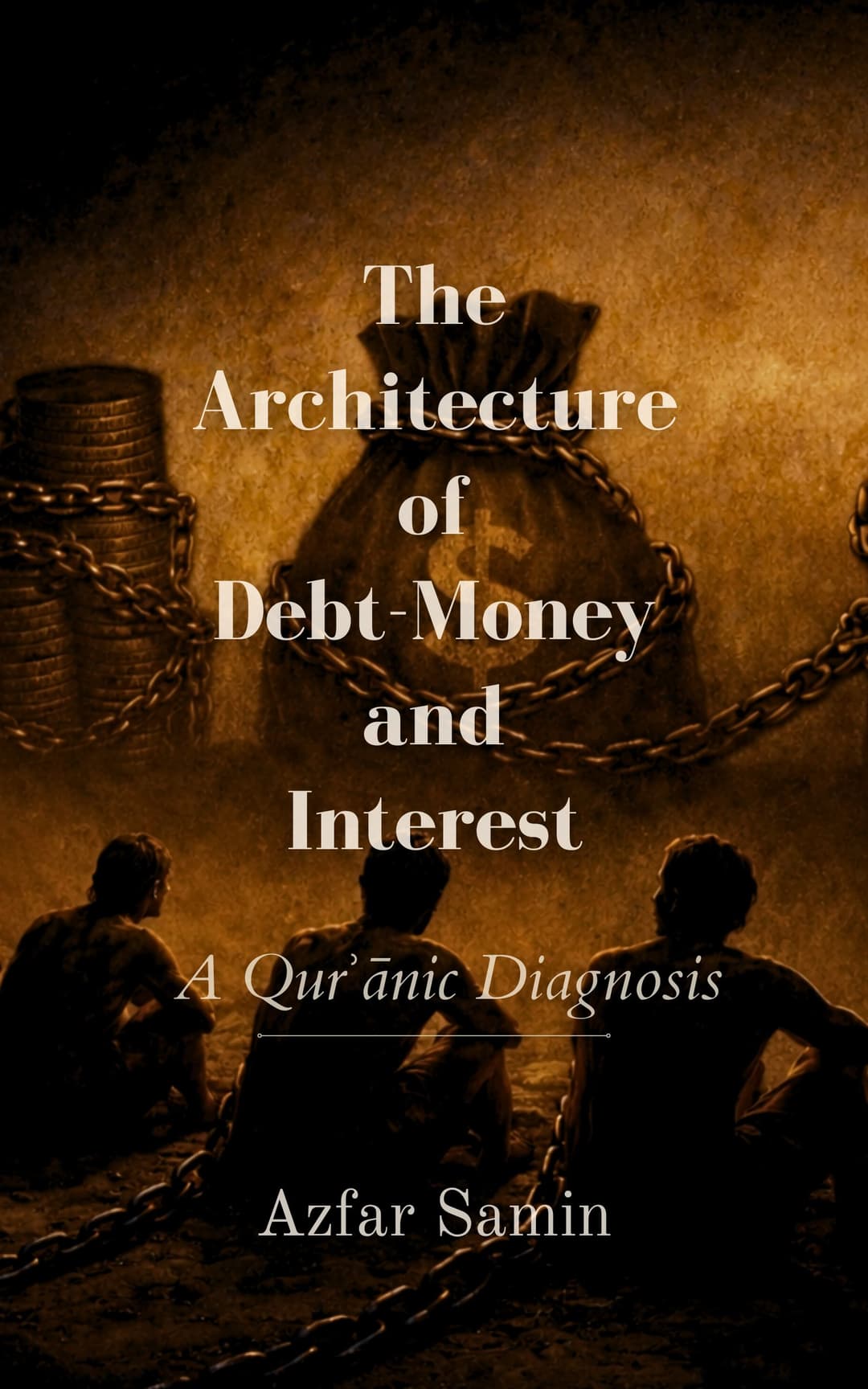
The Architecture of Debt-Money and Interest: A Qurʾānic Diagnosis
A first-principles diagnosis of modern money creation, compounding debt, and systemic exploitation — tested through coherence, correspondence, and calibration.
The core lesson in Plato’s Allegory of the Cave is that most people mistake appearances for reality. When one prisoner is freed and forced to face the source of the shadows, his awakening is painful and disoriented.
Truth hurts.
It confuses.
It contradicts everything he once believed.
The Architecture of Debt-Money and Interest takes the reader through a similar journey of awakening—lifting the curtain on modern monetary mechanics to reveal what money truly is and how interest is embedded into its very structure. Using clear, accessible language, the book explains how central and private banks create money, how debt expands the money supply, and how this compounding architecture quietly transfers wealth upward and distorts society.
It then examines so-called Islamic banking, showing how many “interest-free” financial products replicate the same debt-based mechanisms under different terminology. The book takes the reader through a rigorous pan-textual analysis to demonstrate why modern interpretations do not align with the Qurʾān’s firm position on this controversial subject.
Tracing the Judeo-Christian history of charging interest, the book explores how interest gradually made its way back into European society and evolved into today’s debt-based monetary system. It shows how this system is structurally designed to asymmetrically privilege the banking industry, and why a compounding interest scheme ultimately funnels toward inflation or deflation—both producing devastating socio-economic outcomes downstream.
The book concludes by turning to the Qurʾān not as theology, but as an epistemic framework—testing its own claim that it prohibits interest through internal coherence, real-world correspondence, and its ability to correct systemic drift when societies deviate from sound principles.
The deeper implication is this: while humans naturally mistake consensus for truth and resist uncomfortable reality, only a coherent and calibrated economic framework can minimize harm, restore justice, and foster genuine prosperity without systemic exploitation.